
From Netravati to the Nile: Thinking India Anew at Mangaluru Lit Fest 2026
I walked into the Mangaluru Literature Festival 2026 with a quiet sense of excitement – but also a very personal anticipation. I was especially looking forward to seeing Ruchira Kamboj in person. Having followed her journey closely for years, the opportunity to listen to her reflections on India’s neighbourhood, extra-regional powers, and strategic realism felt deeply meaningful. What I did not expect was how profoundly this festival would stretch my imagination – across geopolitics and spirituality, rivers and space, cinema and civilisational memory.
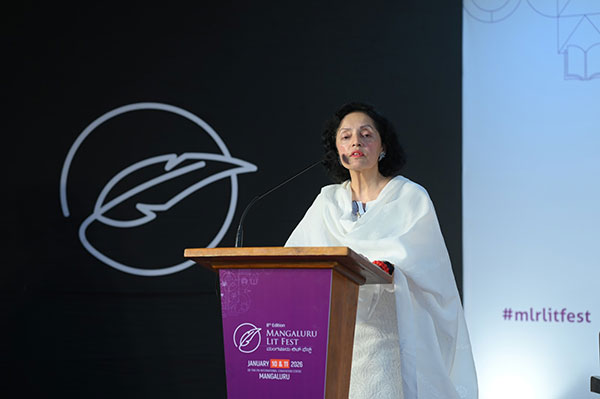
One of the earliest reasons Ruchira Kamboj left an imprint on me dates back to 2014, when she served as the protocol officer during Prime Minister Narendra Modi’s swearing-in ceremony. Even then, she represented diplomacy at its finest – measured, composed, precise, and dignified. Watching her speak at Mangaluru years later only reaffirmed why she had remained a favourite for so long. Her articulation of economic security fusing with national security, the inevitability of calculated multi-alignment, and India’s need for strategic realism without moral posturing came not as theory, but as lived statecraft. There was grace in her clarity, and confidence without theatrics.
Equally nostalgic and intellectually satisfying was watching Sreeram Chaulia live on stage. Having followed his geopolitics and diplomacy series on DD India, there was something almost full-circle about listening to him speak in Mangaluru. Ideas that once travelled through television screens now resonated in a packed auditorium by the coast – underscoring how Mangaluru has quietly emerged as a serious national platform for ideas.
The session “Great Power Games: From Western Decline to Eastern Ascent” stayed with me long after it ended. The most striking takeaway was not about how fast India is growing, but how India must outlast its neighbourhood. In a world driven by noise, impatience, and spectacle, the reminder that power today is patience felt deeply relevant. We are living through a rare historical window – demography, democracy, and policy alignment are finally converging. If India does not ascend now, this opportunity may not return.
That realism continued through discussions on the collapse of the old world order. The acknowledgement that military interventions have imposed enormous costs, and that VUCA is now the default global condition, was refreshingly honest. India’s choices, speakers emphasised, must be guided by strategic independence, hard-headed realism, and self-assurance, not ideological rigidity.
Yet what made Mangaluru Lit Fest truly distinctive was its refusal to let geopolitics dominate at the expense of culture. The festival honoured S. L. Bhyrappa as one of India’s foremost civilisational writers – a scholar-novelist who approached history and society with intellectual courage. For many of us in the right-of-centre ecosystem, Bhyrappa represents literary authenticity rooted in research, realism, and restraint. The discussions around his work reflected quiet confidence rather than defensiveness.
One of the most charming sessions was the book discussion on Red Cherries on the Canara Coast. I remember animatedly discussing the topic with a friend – both of us struck by how a seemingly niche subject opened layers of coastal memory, sport, and community life. The audience engagement was extraordinary. In fact, at one point, the author asked for an audience member’s phone number on stage – to collect an old photograph of a local cricketer that had surfaced during the discussion. It was literature unfolding in real time.
The exploration of underarm cricket as part of coastal sporting culture was especially evocative – not just as sport, but as adaptation, social space, and lived tradition. It reminded us that archives often live with people, not institutions.
The session on news, narratives, and digital storytelling, featuring Smita Prakash and moderated by Surabhi Hodigere, added another layer of depth. Smita Prakash, hailing from Tulu Nadu, has always been a natural defender of cultural rootedness. What makes her remarkable is how effortlessly she embodies India’s plural identity – embracing Punjabi, North Indian, South Indian, and regional traditions without flattening any of them. In her, one sees the truest sense of a Bharatiya Nari – grounded, confident, culturally fluent, and unapologetically Indian. Surabhi Hodigere’s moderation brought balance and sharpness, framing journalism as both responsibility and restraint.
The Kannada sessions gave the festival its cultural spine. A discussion on cinema stood out for its gentle wisdom – urging audiences not to over-intellectualise films, but to receive them as art, absorb them, and learn from them. Conversations on preserving local languages like Kodava, Tulu and on cultural traditions such as Rangabhoomi and Bombayatta, reminded us that civilization survives through practice, not mere preservation.
From Gita for Gen Z to space exploration, from rivers to diplomacy, from cricket to cinema – Mangaluru Lit Fest 2026 demonstrated rare intellectual confidence. It proved that India’s imagination need not be fragmented. As an audience member, I did not feel like a passive listener; I felt invited into a civilisational conversation.
Mangaluru Lit Fest has become more than a regional event. It is now a premier national platform – serious, rooted, and expansive. Walking away, I felt not just informed, but recalibrated. From Netravati to the Nile, the festival reminded me that India’s story, when told honestly, is vast – and still unfolding.
✍️ Sahana A.